Band-Pass 6th Order Parallel Enclosures: Power & Efficiency

The band-pass 6th order parallel enclosure is one of the most powerful box designs for subwoofers. Discover how it works, what makes it different from band-pass 4th, and how to tune it for maximum bass efficiency with the right Qts values.

The Allure of Band-Pass 6th Parallel Boxes

In the universe of loudspeaker enclosures, there is a particular category that often makes bass enthusiasts smile the widest: the band-pass 6th order parallel box. It belongs to the family of band-pass designs but takes the principle to an extreme, delivering extraordinary amounts of bass output with carefully tuned chambers.

Unlike a simple sealed or bass-reflex enclosure, a band-pass box deliberately hides the driver inside and lets the sound reach the listener only through ports. This gives designers freedom to sculpt the sound in a specific frequency window — the “band” in band-pass. With the 6th order parallel variant, this sculpting becomes more dramatic, powerful, and efficient.

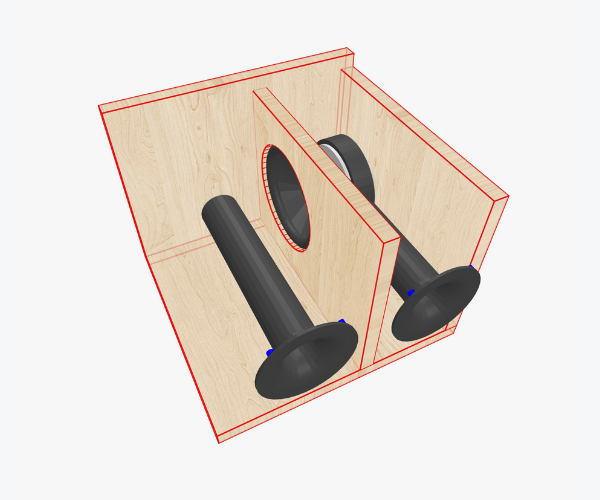
Rendered image from Speaker Box Lite: a 6th-order band-pass parallel enclosure featuring flared, rounded ports that improve airflow efficiency and minimize turbulence.

What Makes It Different from a 4th Order Band-Pass

Many enthusiasts first encounter band-pass design through the 4th order band-pass box, which has one sealed chamber and one ported chamber. It’s compact, straightforward, and can produce satisfying low-frequency output.

But the 6th order parallel enclosure is in another league. Instead of a sealed side, it has two ported chambers — one in front of the driver and one behind it. Both are tuned to different frequencies, and together they create a wider passband with stronger reinforcement. The result? More bass, more pressure, and a box that seems to breathe with energy.

However, the price for this gain is clear: the box tends to be larger. Compared to a 4th order design, the 6th order parallel enclosure usually needs more volume to achieve proper tuning. That means more material, more weight, and a bigger footprint in your car or living room.

Advantages of the Band-Pass 6th Parallel Design

The headline advantage is simple: sheer quantity of bass. Few other box types can compete with the raw output a properly tuned 6th order parallel enclosure delivers. The dual-port action allows the driver to operate efficiently, with reduced mechanical strain, because the two chambers share the load of tuning.

This design is also remarkably efficient. You get more sound pressure out of the same amplifier power compared to sealed boxes, or even compared to certain bass-reflex setups. For people chasing maximum dB in competitions or simply craving room-shaking lows, this efficiency is priceless.

Another benefit is the flexibility of tuning. By adjusting the two ports to slightly different frequencies, you can shape the response curve. Some prefer a wide bandwidth for everyday listening, while others aim for a narrow but aggressive peak that makes bass tracks thunder with authority.

Disadvantages You Should Keep in Mind

Yet no design is perfect, and the 6th order parallel box has its share of drawbacks. The most obvious is size. To house two tuned chambers, the enclosure grows quickly in volume. If space is limited — in a compact car or a small room — it can be challenging to justify.

Another downside is complexity of design and build. While a sealed or even bass-reflex box can be built by beginners with simple formulas, the band-pass 6th parallel requires more precision. If the tuning is off, the enclosure may sound boomy, uneven, or lack the expected efficiency. The ports, in particular, need careful calculation to avoid turbulence or unwanted resonances.

Finally, there is the matter of sound character. Band-pass enclosures are often accused of lacking transparency in the midbass or higher frequencies. The 6th order parallel is optimized for power, not for natural timbre. For pure musicality across a wide range, other box types might be better.

Choosing the Right Qts Values

One of the golden rules when selecting a driver for a 6th order parallel enclosure is paying attention to the Qts parameter. This value, part of the Thiele-Small family, describes the balance between mechanical and electrical damping of the driver.

For band-pass 6th parallel boxes, drivers with lower to moderate Qts values (typically between 0.25 and 0.45) tend to perform best. A lower Qts means the driver is well-controlled and can take advantage of the dual-port design without becoming boomy or muddy. Higher Qts drivers, on the other hand, are often better suited to sealed boxes, where natural resonance control is beneficial.

By choosing the right driver with an appropriate Qts, you ensure the enclosure behaves as intended, maximizing both efficiency and tonal clarity within its intended passband.

Box Tuning Secrets

Tuning a band-pass 6th order parallel box is a delicate dance. Both chambers must be considered not only in isolation but also in how they interact. One chamber might be tuned lower, anchoring the sub-bass region, while the other is tuned higher, adding punch in the upper bass.

The result is a combined response curve with strong output across a wide frequency band. Enthusiasts often experiment with different port lengths and diameters, adjusting until the enclosure sings with the right balance of depth and punch.

This is where software becomes invaluable. Without proper modeling, it’s easy to miscalculate and end up with a box that emphasizes the wrong frequencies.

How Speaker Box Lite Simplifies the Process

Designing a band-pass 6th parallel box by hand can be intimidating, but modern tools make it accessible. Speaker Box Lite, for instance, allows you to enter your driver’s parameters and simulate the box’s behavior before you cut a single piece of wood.

With just a few adjustments, you can see how chamber sizes and port tunings affect the response. Want more output at 40 Hz? You can tweak the port length. Need smoother extension into the sub-bass? Adjust the rear chamber volume. The program handles the math, while you focus on the creative tuning process.

This is especially helpful because mistakes in a 6th order design are costly — rebuilding or modifying the box is not trivial. With Speaker Box Lite, you get it right from the start.

Who Should Choose a Band-Pass 6th Parallel Box?

This enclosure is not for everyone. If you want the most compact box possible, or if you value absolute fidelity across all frequencies, you may find the disadvantages outweigh the benefits.

But if your goal is maximum bass output, high efficiency, and the visceral thrill of deep low-end power, then the band-pass 6th parallel is hard to beat. It thrives in competitive settings, car audio setups, and anywhere listeners crave the physical punch of bass as much as the sound itself.

Conclusion

The band-pass 6th order parallel enclosure represents one of the most ambitious and rewarding box designs in the loudspeaker world. It is large, complex, and sometimes unforgiving, but when done right, it rewards you with bass that feels alive.

By choosing the right driver with a moderate Qts, carefully tuning both chambers, and using modern design software like Speaker Box Lite, anyone can unlock the potential of this powerful design.

For those who love to feel the air move, who want efficiency and power above all else, the 6th order parallel box is not just an option — it’s the pinnacle of bass performance.


Compartilhar: