The Transmission Line Enclosure: Deep Bass with Natural Character

Transmission line enclosures are often called the “audiophile’s secret” because of their ability to deliver rich, deep, and articulate bass. Unlike sealed or bass-reflex boxes, a transmission line uses an acoustic labyrinth to guide and control the rear wave of the driver. This article explores their advantages, disadvantages, best driver choices, the special quarter-wave design, and how to simulate and calculate them in Speaker Box Lite.

Why Transmission Line Boxes Are Special

Most people’s first encounter with speaker enclosures begins with sealed or bass-reflex designs. Both are practical, efficient, and widely used. Yet there is another path, one that audiophiles often treasure for its unique blend of bass extension, control, and musicality: the transmission line enclosure.

At its heart, a transmission line box is about guiding the rear wave of the speaker cone. Instead of simply trapping it (sealed) or letting it resonate in a tuned vent (bass-reflex), the transmission line channels the energy through a long, damped tunnel. This acoustic labyrinth gradually absorbs and aligns the wave, preventing destructive cancellation while reinforcing the lowest frequencies. The result? Bass that feels deep yet natural, with a kind of effortless authority that other enclosures struggle to match.


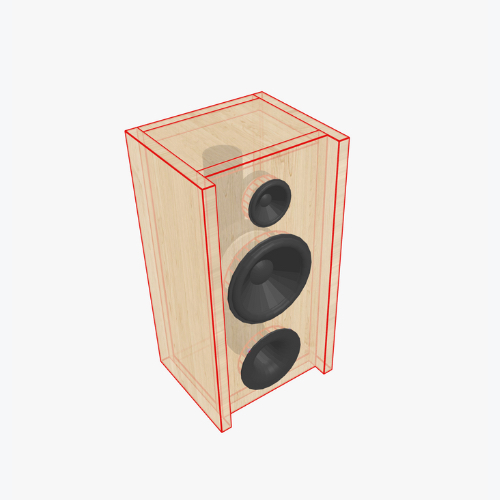
Rendered illustration of a simple transmission line enclosure with a line length of 1.4 meters.
Schematic representation of a transmission-line enclosure
Schematic representation of a transmission-line enclosure: the front wave (green arrows) radiates directly, while the rear wave (red arrows) travels through a long, damped channel. The line’s length and damping material shift the rear wave into phase with the front wave at low frequencies, reinforcing bass and reducing cancellations.

The Bass Experience: Quantity Meets Quality

One of the most celebrated strengths of a transmission line is the quantity of bass it can produce relative to the driver size. A modest woofer, when properly loaded into a transmission line, can reach surprisingly low frequencies without requiring massive cone area or huge amplifier power. The long line acts almost like an acoustic transformer, extending response and adding weight to the lower registers.

But what makes transmission line bass stand out is not just the quantity. It is the quality. Listeners often describe it as “tight,” “well-damped,” or “lifelike.” Unlike some reflex boxes that can sound boomy or one-note when pushed, a well-designed line gives notes their proper length and decay. Kick drums feel punchy yet controlled. Double bass strings resonate naturally without overhang. Electronic basslines gain depth without mud.

This makes transmission lines particularly beloved in home hi-fi and studio monitors where accuracy matters as much as impact.


Efficiency and Practicality

Efficiency is another strong card. Although not quite as efficient as certain horn designs, transmission lines often outperform sealed boxes of the same driver. They make better use of the driver’s rear radiation, turning what would otherwise be wasted energy into useful output.

This means that, compared to a sealed box, you may get more SPL (sound pressure level) from the same amplifier power. And compared to a bass-reflex, you avoid the sharp resonant peak that can color the sound. Instead, you get smoother extension and a less “boxy” character.

Of course, there is no free lunch. Transmission line boxes are usually larger than sealed or reflex designs. The labyrinth must be long enough—often comparable to a quarter of the wavelength of the driver’s resonant frequency. This translates into enclosures that can be tall, deep, or internally complex. Builders often describe them as furniture-sized projects rather than compact boxes. But for many enthusiasts, the sound is worth the extra volume.


Best Drivers for Transmission Line Designs

Not every speaker driver is equally suited for transmission line use. To understand why, it helps to recall two key parameters from the Thiele-Small set: Qts and Fs.

  • Qts is the total quality factor of the driver, balancing electrical and mechanical damping. Drivers with a moderate to low Qts (around 0.25–0.45) generally perform best in transmission lines. A very high Qts driver (above 0.6) tends to sound loose, while a very low one may struggle to take advantage of the line’s reinforcement.
  • Fs, the resonant frequency of the driver, sets the natural “starting point” for how low it can play. Since the line length is usually tied to this parameter, a low Fs driver is ideal. The deeper the native resonance, the more powerful and extended the resulting bass.

For example, a woofer with Fs around 30 Hz and Qts around 0.35 is a good candidate. Such a driver, when placed in a properly tuned line, can achieve bass response that reaches into the sub-bass territory with remarkable smoothness.


The Quarter-Wave Transmission Line


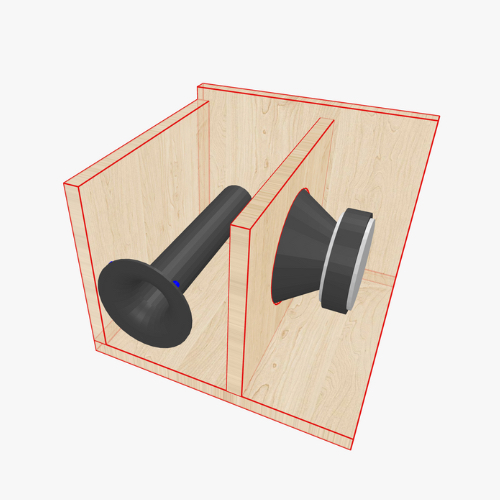
Rendered illustration of a simple quarter-wave transmission line, 1.4 meters long, folded three times with the line reversed at the mouth.

One of the most famous variations of this design is the quarter-wave transmission line. The principle is simple but elegant: the line length is made approximately equal to one quarter of the wavelength of the driver’s resonant frequency.

Mathematically, the length L is often estimated as:

L = c/(4 * Fs)

where c is the speed of sound (about 343 m/s at room temperature), and Fs is the driver’s resonant frequency in hertz.

For instance, if a woofer has Fs = 30 Hz, the quarter-wave length would be about 2.86 meters. That does not mean you need a box that tall. Designers fold the line inside the cabinet, creating internal partitions or curves that fit the path into a manageable form factor.


Choosing the Right Line Area

Length is only part of the story. The cross-sectional area of the line also matters. Too narrow, and the airflow becomes restricted, leading to chuffing or compression. Too wide, and the damping of resonances becomes less effective. A good starting point is to make the line’s cross-section similar to or slightly larger than the driver’s effective piston area (Sd). Fine adjustments depend on the desired balance between extension and tightness.


The Role of Damping

Another special aspect of quarter-wave lines is damping material. By filling parts of the line with absorbent fiber, you can smooth out unwanted resonances and prevent higher-frequency leakage. This damping lets the quarter-wave resonance shine through while keeping the midrange clean and free of echoes.


Advantages of Transmission Line Boxes

  • Deep, extended bass that outperforms sealed boxes of similar size.
  • Natural, controlled low-frequency character—notes have proper decay, avoiding boominess.
  • Better efficiency than sealed designs, using both front and rear radiation effectively.
  • Flexibility in tuning by adjusting line length, cross-section, and damping material.
  • Compatibility with smaller drivers, which can achieve surprisingly low extension when properly loaded.


Disadvantages and Challenges

  • Large enclosure size compared to other designs. Even folded, the lines demand significant internal volume.
  • Complex construction, requiring careful folding, bracing, and damping placement.
  • Sensitive to driver choice—not all woofers will work well, making careful selection essential.
  • Trial and error in tuning, since small changes in damping or geometry can noticeably affect the sound.

Despite these challenges, enthusiasts often consider the effort a worthwhile journey. Few designs reward patience with such immersive bass.


Designing Transmission Lines with Speaker Box Lite

In the past, transmission line enclosures were the domain of seasoned engineers with graph paper, calculators, and hours of prototyping. Today, tools like Speaker Box Lite bring that power to everyone.

Speaker Box Lite allows you to simulate transmission line boxes, experiment with different line lengths, areas, and damping factors, and instantly see the predicted frequency response. You can input the driver’s parameters (Fs, Qts, Vas, Sd, etc.) and explore how changes to the line design affect the bass output.

Whether you are building your first quarter-wave tower or refining a complex folded labyrinth, the software takes the guesswork out of the process. And because it generates 3D previews and blueprints, it also makes the practical step of cutting wood and assembling the box far more approachable.


Conclusion: A Bass Lover’s Dream

The transmission line enclosure is not the simplest path to good bass. It demands space, care, and a suitable driver. But for those willing to embrace its labyrinth, it delivers a kind of bass that is both abundant and refined—a marriage of quantity and quality that keeps music honest while making movies thunder.

Whether you seek audiophile nuance, studio accuracy, or simply want your favorite tracks to breathe with life, the transmission line deserves your attention. And with Speaker Box Lite guiding the design, this once-mystical technique is now accessible to every builder ready to dive deeper into the art of sound.


Поделиться: