The Band-Pass 6th Series Box: Power, Precision, and the Quest for Bass

The band-pass 6th series enclosure is one of the most fascinating and demanding box designs in the world of speaker building. Discover its advantages, disadvantages, ideal driver parameters, and how tools like Speaker Box Lite make the design process much more approachable.

Introduction: A Box Built for Bass Lovers

When we talk about loudspeaker enclosures, some designs immediately stand out for their raw practicality: the sealed box with its clarity, the bass-reflex with its balance between size and output. But then, in the upper echelon of bass-heavy enclosures, lives a design both revered and feared: the band-pass 6th series box.

It is not a beginner’s box. It doesn’t forgive mistakes in calculation. But when executed correctly, it unleashes a tidal wave of low-frequency energy. The 6th series is a true specialist—designed for listeners who demand not just bass, but a physical experience of sound pressure that goes beyond the ordinary.

Let’s open the lid—figuratively—and take a closer look at what makes this enclosure so captivating.

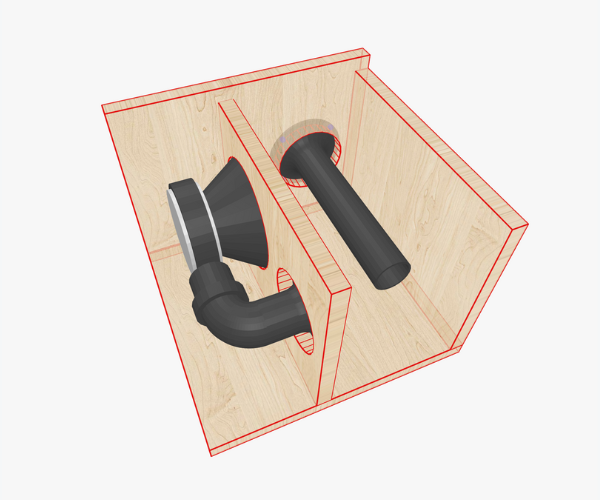
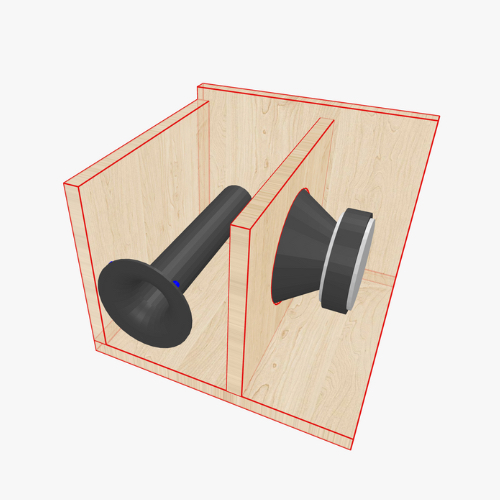
Rendered image from Speaker Box Lite: a 6th-order band-pass series enclosure featuring flared, rounded ports that improve airflow efficiency and minimize turbulence.

What Exactly is a Band-Pass 6th Series Box?

To understand the 6th series band-pass enclosure, it helps to imagine it as a hybrid of two worlds. The driver itself sits inside a sealed chamber on one side and a ported chamber on the other. But unlike the 4th order band-pass—where only one chamber is ported—the 6th series doubles down: both the front and rear chambers are vented.

That means the sound waves generated by the speaker are filtered twice: once through the rear port, and once through the front port. The result is a system that can be tuned with impressive precision, delivering massive bass output across a carefully defined frequency range.

It’s no wonder car audio enthusiasts and SPL (sound pressure level) competitors adore this type of enclosure. It’s loud, it’s commanding, and it can feel like sitting in the middle of a rolling thunderstorm.


Advantages: Why Builders Choose the 6th Series

The main reason anyone takes on the complexity of a band-pass 6th series box can be summed up in one word: bass.

Unlike the 4th order band-pass, which already boosts low frequencies, or the 6th parallel design that balances efficiency across a broader spectrum, the 6th series enclosure focuses like a laser on output in a chosen range. When tuned right, it delivers astonishing levels of sound pressure—bass you don’t just hear, but feel in your chest, in your skin, even in the vibrating surfaces of the room or vehicle.

Another advantage is efficiency. For a given driver and amplifier power, the 6th series box often produces more output than a simpler bass-reflex or even a 4th order band-pass. That means you can achieve serious SPL without requiring absurd amounts of power.

Finally, the tuning flexibility of having both chambers ported is a major plus. Builders can choose to emphasize different bandwidths, sculpting the response curve depending on whether they want chest-thumping mid-bass or ultra-low sub-bass rumble.


Disadvantages: Why It’s Not for Everyone

With great power comes… a fair share of compromises.

The size of a 6th series box is not modest. Compared to a 4th order band-pass, which already takes up more space than a sealed or reflex design, the 6th series requires even more internal volume. And when we compare it to the 6th parallel, the series alignment tends to demand bigger chambers. This makes it less than ideal for tight spaces, like compact cars or small living rooms.

Then there’s the matter of complexity. Designing a 6th series band-pass box without proper tools or experience can quickly lead to disaster. A small mistake in volume ratios or port tuning, and instead of thunderous bass, you may end up with a box that sounds hollow, boomy, or simply disappointing.

The frequency response is another trade-off. Because this design is tuned to a narrow range, it can be spectacular in its sweet spot but weak outside of it. Unlike a bass-reflex, which gives you a usable wide response, the 6th series is far less forgiving.

Lastly, there’s construction difficulty. Two ports, two chambers, careful bracing—it’s a demanding build, not just on paper but in the workshop.


Bass Quantity Compared to Other Band-Pass Designs

So how does the 6th series compare to its close relatives?

  • Versus Band-Pass 4th Order: The 4th order delivers good bass and is more compact. But the 6th series produces more bass output—sometimes dramatically more—at the cost of size and bandwidth. If the 4th order is a well-rounded athlete, the 6th series is a heavyweight bodybuilder.
  • Versus Band-Pass 6th Parallel: The parallel version of the 6th order spreads its energy more evenly across frequencies, offering a more versatile sound. The series version, by contrast, funnels its energy into a smaller bandwidth, making it louder at its peak but less universal. It’s like choosing between an all-terrain vehicle and a drag racer.


Tuning the Beast: Ports and Precision

The real artistry of the 6th series lies in its tuning. Because both the front and rear chambers are vented, designers can play with ratios and port dimensions to shape the response.

Want a wide, aggressive mid-bass punch? Tune the ports higher. Craving that deep, earthquake-like rumble? Tune them lower. The possibilities are almost endless, but the margin for error is razor thin.

This is where modern tools come into play. Speaker Box Lite, for example, allows you to model a 6th series band-pass box with precision, simulating how changes in chamber volume and port length affect the final response. Instead of endless guesswork and wasted wood, you can design with confidence, adjusting variables on-screen until you achieve the perfect balance.


Choosing the Right Driver: Qts and Beyond

Not every speaker is a good candidate for a 6th series band-pass box. One of the most critical parameters to watch is Qts, the total Q factor of the driver.

For the 6th series design, drivers with low to medium Qts values (typically between 0.2 and 0.5) perform best. Low-Qts drivers tend to have stronger motor control, which works in harmony with the dual-chamber resonance of the box. High-Qts drivers, by contrast, often sound muddy or uncontrolled in this type of enclosure.

Other parameters—Fs (resonant frequency) and Vas (compliance)—also matter, but Qts is the guiding star when selecting a driver.


Why Speaker Box Lite Makes the Difference

If building a 6th series band-pass enclosure sounds daunting, that’s because it is. But with the help of Speaker Box Lite, it becomes manageable.

The app doesn’t just calculate chamber volumes and port lengths; it lets you visualize how the driver and enclosure interact. You can tweak Qts, Vas, tuning frequencies, and instantly see the impact on output, efficiency, and bandwidth.

For DIY enthusiasts and professionals alike, this is a game-changer. Instead of relying on trial and error—or worse, guesswork—you have a clear roadmap from driver specs to finished enclosure. And because Speaker Box Lite supports multiple box types, you can directly compare your 6th series design with alternatives like bass-reflex or 4th order band-pass to decide which path truly suits your project.


Conclusion: A Box for the Bold

The band-pass 6th series enclosure is not for the faint of heart. It’s big, it’s demanding, and it punishes sloppy design. But for those willing to put in the effort, the reward is immense: bass so powerful it becomes physical, efficiency that makes the most of your amplifier, and the satisfaction of mastering one of the most challenging box designs in audio engineering.

For car audio competitors, bass fanatics, or simply those chasing the ultimate low-frequency thrill, the 6th series remains a crown jewel. And with modern tools like Speaker Box Lite, designing this beast no longer requires a degree in acoustics—just passion, patience, and the desire to feel the music as much as hear it.


Compartir: